Tuesday, April 6, 2010

The Girl who Played with Fire By Stieg Larsson

Of course, I wouldn’t have read The Girl Who Played With Fire without first reading The Girl with the Dragon Tattoo. I can happily report that I have enjoyed The Girl Who Played with Fire as much or more than the first installment in the series. The original book featured recent crimes and not-so recent crimes, and we certainly get more of the same in this book.

One of my favorite things about the first book is that it was an investigation into a mysterious crime from many years ago. My favorite thing about this book is that Investigators Blomvkist and Salander are more personally involved in the investigation that takes place. Though Blomvkist is technically working on articles for his news magazine Millenium, he contributes the amount of energy that he does because of his personal involvement. Larsson successfully creates suspense right to the last page.

I suspect that people who enjoyed The Girl with the Dragon tattoo will enjoy this book as well; there is much to be said for reading the first book before starting this one. As with any series, there is catch up information for those who didn’t read the book, or who haven’t read it recently, but Larsson builds on many relationships that were established in the first book. In my opinion, this would be quite confusing if you haven’t read The Girl with the Dragon Tattoo.

Normally, I don’t read many suspense/thriller novels, even though I typically enjoy them. The fact that this series is a bit of a sensation has attracted me though. I recommend the book, and I’m looking forward to The Girl who Kicked the Hornet’s Nest.

Monday, March 8, 2010

The Checklist Manifesto by Atul Gawande


When I initially read an NPR review about this book, I was immediately interested. Not only is Gawande attempting to present solutions to preventable failures in the medical professions, but in other business environments as well. The Checklist Manifesto is Gawande’s non-fiction account of how to construct and implement checklists in meaningful ways. His particular area of interest is that of safe surgery, but he also offers examples in construction, aviation and investments, to name a few.

The style of this book is very anecdotal. He immediately grabs the reader’s attention by sharing a couple gory surgery horror stories about failures to address key steps or pieces of information in operations. He continues this pattern throughout the book, each section tells a story about how he learned about checklists in a variety of settings and how each checklist is effective or not. His journey is that of a surgeon who is researching checklists for the WHO; he tells us how he came up with the idea, how his checklists were constructed (and re-constructed), and how checklists have measurably changed surgical practices in several of the world’s hospitals.

As an aside, I can barely fathom how Gawande manages to write books in between all of his other jobs. He is a surgeon, a director for patient safety with the WHO (World Health Organization), Harvard professor and father. Any one of these tasks seems like it could be all-consuming. He must be very organized – I suppose he uses checklists to keep track of it all.

Side note: This is not Gawande’s first book. Check out Complications: A Surgeon’s Notes on an Imperfect Science (RD 27.35 .G39 A3 2002 )

Tuesday, March 2, 2010

36 Arguments for the Existence of God By Rebecca Goldstein

The title of this book is misleading for a couple reasons. First, it is not a list of 36 arguments for the existence of god (although this information is in the appendix). Second, the title makes it sound like the author is making a case for god’s existence. Even if you take the novel format into account, this is not the case (The appendix that includes arguments for god’s existence only includes the arguments so they can be refuted). When I initially discussed this with a friend, I was chastised for not calling the book 36 Arguments for the Existence of God: A Work of Fiction (I kind of think it is a pain to include this subtitle in conversation), but it does help one know what to expect.

The book takes place during a couple weeks of Cass Seltzer’s career; he is a university professor of the psychology of religion and an author who has recently written a book about atheism. The book is not a list of 36 arguments for the existence of god, but he did include an appendix in his book (I believe that Goldstein’s appendix is meant to be Seltzer’s appendix). Even though the book spans a short amount of time, approximately half of the chapters are flashbacks, so the reader really gets to know Cass from the time he was in his 20’s. Several periods of Cass’s life are explained, his relationship with his eccentric mentor, his background as an Orthodox Jew, a failed marriage and a happy new relationship.

Although this is a book about one man’s explorations in religion and life, we can easily put Cass Seltzer’s atheism in perspective. Can’t we be good without the expectation of an eternal reward? Can’t we love our fellow humans without feeling that we are obligated by our religion? In my opinion, the book is less about the faiths that people embrace and more about the ways that they share their faiths and lives with others.

Thursday, February 18, 2010

Poll Everywhere - mostly free surveys!

I originally saw the program Poll Everywhere on a different blog that discussed technology in school libraries, so I can’t take all of the credit. But it seems like such a fun idea to engage students in classroom discussion. Almost all of Southwestern’s students carry cell phones to class, right? So why not use a poll to ask students questions about projects, social issues or classroom topics? Students can respond by using their cell phones to text their vote or by voting online. When you include the polls in presentations or websites, the results will update in real time.

Of course, this program is only free to an extent. If you only want to poll 30 or fewer people, the program is free, but if your audience is larger, there is a monthly subscription cost. For most class sizes, a free subscription would probably be all that was needed.

This seems like it would also be a great way to get feedback and opinions from people in class who may not be as outspoken as others. Or in classes that talk about current events, students may feel concerned about voicing unpopular opinions. For example, some students may feel more comfortable expressing their opinions about controversial topics (abortion, international politics) anonymously.

And classrooms are certainly not the only place where this tool could be used – I’m thinking of creating a poll on library usage!

Thursday, February 4, 2010

Create Great Puzzles

For the past few months, I’ve been including word search puzzles in the student newspaper, The Southwestern Eagle. Just one of the many reasons that I have for doing this is the fact that they are so easy to make! The site http://www.blogger.com/www.puzzle-maker.com/ makes it easy for me to supply a list of words and generate a puzzle that includes them all.

Now, as far as using word search puzzles for actual school assignments, I don’t really see the point. But the site also creates crossword puzzles that could be lots of fun. For example, instructors may want to compile lists of review questions (which most probably do already) then have this program make a crossword puzzle. Each clue could be a review question and the answers would be the puzzle solutions. This is just one idea that I happened to think of, I'm sure there are many other ways that teachers could very easily incorporate this into their curriculum.

This may not do anything to actually improve the work, but it may help make it more fun!

Monday, January 25, 2010

Zamzar


Zamzar will convert your files from one format to another. For example, if you do you do your typing at home in Microsoft Works or Open Office, Zamzar will magically transform your papers into Office 2003 or Office 2007 documents that you can edit and print out at school. Zamzar also works with many music and video files and will also turn Word documents into PowerPoints, Microsoft Publisher documents, and even HTML.

The downside is that the process isn't necessarily instantaneous: you have to upload your document into Zamzar and then wait for the program to email you the converted document.

If you need a document converted right away, come ask for help in the library. We'll probably be able to help you find a computer that has the Office compatibility pack loaded on it, or we'll be able to find some other way of facilitating the conversion process.

Thursday, January 21, 2010

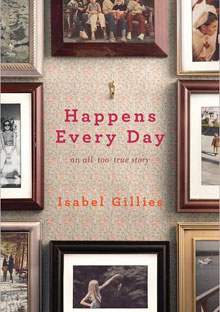
Review: Happens Every Day by Isabel Gillies

I was really excited to read the book Happens Every Day by Isabel Gillies. And not just because of an attractive cover or prominent display. I saw a recommendation on NPR - other NPR recommendations have been very enjoyable. I have lived in Ohio my entire life and this memoir is set in Oberlin, Ohio; I try to seek out literature from or about Ohio. It is also a non-fiction book by a female author. I sort of knew what the book was about, and was expecting an uplifting story about a strong woman.

Here’s the gist of the book: Isabel Gillies and her husband have a very dramatic relationship. They get married and have two kids. Gillies moves from New England to Ohio with her husband who is a poetry professor. After a while, he meets and falls in love with one of the other professors at Oberlin. They separate. Don’t worry, I haven’t just given away the entire book, this is all mentioned at the beginning.

It sounds like I’m leaving out a lot, but I’m really not. When I got to page 17 of this 250+ page book, I set the book down and said to myself “How on earth will she manage to stretch this into a book length memoir?” The author must have wondered what type of information she ought to use as filler too. She seems to have settled on descriptions of designer apparel and home décor items, but she also includes repetitive memories of her privileged upbringing and expressions of amazement at the fact that Ohio is actually livable rather than being a barren wasteland.

I don’t know whether I could briefly sum up the aspects of this book that bothered me. The voice of the novel just really began to irritate me. She struck me as being a frantic, needy, hypersensitive woman who defined herself solely based on appearances and her husband’s status. But it may just be that I don’t relate well to woman and I’m not really the right audience for the book.

For a more enjoyable book about a philandering professor at a small Liberal Arts college, try Zadie Smith’s On Beauty. It isn’t non-fiction, but I found it much more interesting than Happens Every Day.